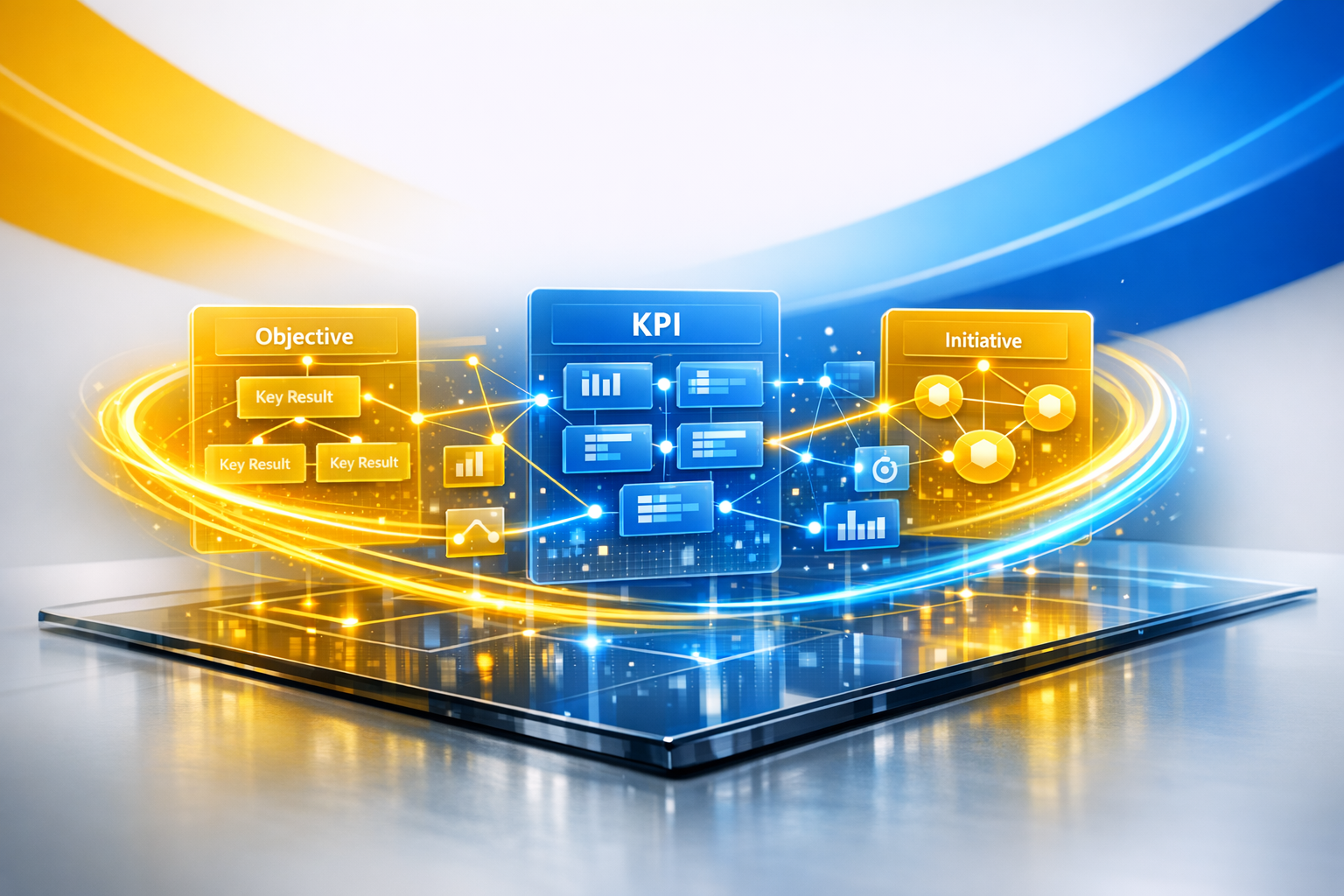
Executive summary: In large organizations, strategies rarely fail in PowerPoint-they fail in execution. AI-driven OKR software is transforming how enterprises align thousands of people, adapt priorities in real time, and foster genuine accountability-all without adding bureaucracy. This article explores how AI-powered OKR platforms work, how they outperform traditional OKR tools, and which practical steps mid-to-large enterprises in the DACH region can take in the next 12 months.
The new mandate: Strategy execution at the pace of change
Across industries, leaders often share the same frustration: the strategy is strong, but results lag behind.
Research shows that around 67% of well-crafted strategies fail in execution-not planning.[1] For complex enterprises with distributed teams, hybrid work, and multiple transformation programs, this gap is widening.
Three themes dominate C-level conversations:
- Speed: How quickly can we turn priorities into action-and track impact?
- Alignment: How do we ensure everyone sees exactly how their work contributes to strategy?
- Accountability: How can we create clear ownership and transparent follow-up without overloading with reporting?
Meanwhile, AI adoption is accelerating.
In 2024, a global survey found that 33% of organizations already see AI as "widely implemented and driving critical value," up from 28% the year before.[2] AI is now entering the strategy domain: about 21% of companies use AI for strategy and corporate finance decisions in 2024.[3]
Yet most enterprises still run strategy execution and OKR management with spreadsheets, decks, and basic OKR tools. AI-driven OKR platforms change this.
Why traditional OKR tools plateau in enterprise environments
OKRs help focus organizations on outcomes, not just activities. But in large, regulated, matrixed companies, "plain" OKRs and basic tools hit their limits fast.
Common pain points in DACH enterprises:
- Fragmented goal landscapes across units, countries, and functions
- Manual reporting for management reviews, rebuilt every quarter in PowerPoint
- Duplicate or conflicting priorities because dependencies are invisible
- Static alignment: OKRs set and forgotten until the next cycle
- Low accountability: owners unclear, updates irregular
Traditional OKR software improves visibility but often acts as a passive repository-it stores objectives and key results instead of actively supporting execution.
At the same time, the broader AI picture shows a gap. While 93% of organizations use AI in some form, only about 7% have fully embedded AI governance frameworks.[4] Leaders notice: AI pilots are common, but cohesive, governed systems for AI-supported strategy execution are rare.
AI-driven OKR platforms address this gap directly.
From dashboards to decision engines: What AI-driven OKR platforms actually change
Modern AI-powered OKR platforms-like Workpath, WorkBoard, and others[5]-do much more than store goals. They bring OKRs, KPIs, initiatives, and Business Reviews into a unified operating model, enhanced with AI.
Key capability shifts:
1. From manual drafting to AI-assisted, high-quality OKRs
AI accelerates and improves how teams draft, refine, and align OKRs:
- Draft objectives and key results from strategy, roadmaps, or unstructured text
- Score OKRs for clarity, measurability, and value focus
- Suggest metrics and targets based on historical KPIs
- Flag overlaps or contradictions between teams' OKRs
Workpath and similar platforms embed these features, enabling teams to create strong drafts in a single session. This frees up time for real alignment instead of endless editing.
2. From static scorecards to live impact chains
AI OKR platforms now offer impact chains: they map inputs (resources, budgets) to outputs (initiatives, features), outcomes (business results), and long-term impact (key KPIs).
This enables:
- Rapid identification of initiatives lacking strategic value
- Clear visibility of how work affects higher-level KPIs, nearly in real time
- Evidence-based leadership decisions on where to invest or stop
Workpath integrates these impact chains into its AI model, making cause-and-effect links in OKR strategy actionable. See the AI-powered strategy execution and impact chains overview for real-world application.
3. From manual Business Reviews to AI-orchestrated review rhythms
AI agents can now:
- Pull live KPI and KR data from sources like Power BI and BI warehouses
- Aggregate across products or regions
- Highlight variances, risks, and patterns
- Draft executive summaries for QBRs and MBRs
With Workpath, PMO leaders report saving about 40% of time previously spent preparing manual Business Review reports, thanks to AI automation. That reclaimed time can be focused on high-value decisions.
Discover more in Workpath's Analytics Suite.
4. From opaque ownership to transparent accountability
AI-driven OKR management creates accountability through:
- Clear mapping of owners to objectives, key results, and initiatives
- Automatic surfacing of stalled items for follow-up
- Nudges for updates before reviews
- Visible dependencies and contribution requests
The result: fewer surprises in steering meetings and clearer roles for leaders and teams.
How AI-driven OKR software boosts speed
Speed in strategy execution isn't just "doing more, faster"; it's about sensing, deciding, and acting before competitors. AI-enabled OKR platforms support this across three levels.
Shorter, smarter planning cycles
AI reduces friction in each OKR cycle by:
- Pre-populating drafts from prior cycles, strategy docs, and KPI trends
- Suggesting focused, non-overlapping objectives per team
- Highlighting objectives that are unrealistic, too easy, or misaligned
Organizations can run shorter OKR cycles (quarterly or even bimonthly) without overwhelming teams. For dynamic sectors like tech, logistics, or energy, this responsiveness is a distinct advantage.
Real-time feedback loops
Once cycles are running, feedback-enabled by AI-drives speed:
- Live dashboards show leading (not just lagging) indicators
- AI flags early anomalies ("This KR is off track given current trend")
- Teams adjust initiatives mid-cycle, not waiting for new quarters
Combined with agile cadences, AI-powered OKR management transforms strategy from static plans into a living, responsive system.
Maintaining alignment at scale: OKR alignment powered by data and AI
OKR alignment is easy in small teams, but complex across thousands of people and multiple legal entities.
AI-driven platforms tackle alignment on three fronts:
Vertical alignment (strategy -> portfolio -> team)
Impact chains and hierarchical OKRs ensure every team objective links to a higher-level outcome. AI can:
- Recommend parent-child relationships between OKRs
- Flag team goals that don't support any strategy
- Suggest consolidation where several teams pursue the same outcome
Horizontal alignment (cross-functional collaboration)
Alignment gaps often arise between business units and functions. Modern platforms:
- Visualize dependencies for easy contribution requests
- Show shared reliance on KPIs, capacity, or systems
- Use AI to anticipate conflicts and bottlenecks
Tool and data alignment (where execution happens)
Alignment falters when strategy and execution live in different tools. Workpath and other enterprise platforms integrate with Jira, Azure DevOps, SAP, Microsoft Teams, and BI tools, ensuring one source of truth.
Especially in DACH enterprises with complex SAP landscapes, these integrations mean teams update OKRs automatically, reducing manual effort and improving accuracy.
Accountability without bureaucracy
Leaders often worry "more accountability" means more control and meetings. AI-driven OKR management turns this notion around.
Accountability in an AI-powered OKR platform:
- Every key result has a named owner and automated reminders
- Risk flags trigger when results stray from targets
- Reviews focus on decisions, not status updates
- Teams and management share visibility-no hidden spreadsheets
The impact is proven: Workpath clients like DB Schenker report measurable gains in transparency and goal attainment after introducing OKRs and a modern OKR platform.
At DB Schenker, Workpath's platform data showed a double-digit increase in goal achievement for well-prepared teams fully applying the OKR framework.[6] This is about building a shared, data-driven picture-not policing teams.
Explore the DB Schenker OKR case study for practical insights.
Comparing traditional OKR tools and AI-driven OKR platforms
The table below summarizes the key differences to consider when evaluating OKR software:
| Dimension | Traditional OKR tools | AI-driven OKR platforms (e.g., Workpath) |
|---|---|---|
| Core focus | Tracking OKRs, check-ins | Holistic outcome management (OKRs, KPIs, initiatives, Business Reviews) |
| OKR drafting | Manual templates | AI-assisted drafting, quality checks, alignment suggestions |
| Alignment | Basic hierarchy | Impact chains, dependency mapping, contribution requests |
| Reporting | Static dashboards, manual slides | AI-generated scorecards, automated reports, live KPI integrations |
| Speed of adaptation | Quarterly updates | Continuous insights, anomaly detection, mid-cycle recommendations |
| Governance & security | Basic permissions | Enterprise security (ISO 27001, TISAX), EU data residency, AI governance |
| AI transparency | Limited | Explainable AI, audit trails for AI actions |
| Enablement | Docs and some training | Structured enablement, AI bootcamps, workshops |
For mid-to-large enterprises, the greatest value comes from treating the OKR platform as a strategic operating system, not just a goal-tracking tool.
A pragmatic roadmap: From pilot to AI-powered operating model
For strategy, transformation, or portfolio leaders in the DACH region, how do you move from idea to reality in 12-18 months?
Step 1: Clarify outcomes and governance first
Before choosing tools, define:
- Which business outcomes you want to drive (e.g., margin, NPS)
- Your steering model (review cadence, decision rights)
- Which frameworks you'll combine (OKRs, SAFe, Hoshin Kanri, etc.)
This ensures your platform and its AI features fit your steering model, not the other way around.
Step 2: Start with high-impact value streams
Avoid scattered pilots. Focus on:
- 1-2 value streams or business units under strategic pressure
- Leaders ready to experiment with AI-enabled steering
Run 2-3 OKR cycles in these units with a platform like Workpath, including:
- AI-assisted OKR drafting
- Automated dashboards
- AI-generated review materials
Step 3: Use pilot data to refine the model
Track both business outcomes and execution quality:
- Goal achievement
- Reporting time saved
- Number of cross-functional contribution requests
- Cycle time from decision to team-level OKR update
Organizations implementing formal, data-driven strategy execution processes see much higher rates of superior performance than those without.[7] Use your results to justify scaling.
Step 4: Scale with enablement and AI literacy
While AI adoption is widespread, about 70% of challenges with scaling AI are people and process-related, not technical.[8] This also applies to strategy execution: success relies on behaviors and learning.
Invest early in:
- Leader training on AI-supported decision-making and OKR practice
- Communities of practice for champions and PMO leads
- Change-management support
Programs like Workpath's Strategy Execution Masterclass, OKR Masterclass, and AI Bootcamp for building strategy-supporting AI agents help build these skills at scale.
Step 5: Industrialize AI governance
As AI automates more tasks, maintain trust:
- Set guardrails for AI decisions
- Meet data residency and privacy needs-critical for EU and regulated industries
- Keep audit trails for AI-generated recommendations and reports
Workpath and similar platforms offer German data residency and certifications such as ISO 27001 and TISAX for sensitive sectors.
For European enterprises, a blend of German data residency, ISO 27001 and TISAX certifications, and explainable AI recommendations is becoming standard for enterprise-grade strategy execution platforms.
Actionable conclusions for enterprise leaders
If you own strategy execution, portfolio steering, or transformation, focus on these three actions:
- Reframe OKR software as your strategy execution platform. Seek integrated capabilities: OKRs, KPIs, initiatives, and reviews in one system.
- Let AI reduce friction, not centralize control. Use AI for drafting, checks, detection, and reports to free up leaders for decisions and coaching.
- Design for speed, alignment, and accountability. Define cadences, ownership, and decisions-then select a platform that supports them.
Leaders making this shift see immediate benefits. Workpath customers report faster strategy execution, major time savings in Business Reviews, and double-digit goal attainment improvements when OKRs and AI-powered Outcome Management are combined.[6]
True competitive advantage in the DACH region will come not from drafting better strategies-but from executing them faster, more coherently, and more intelligently than ever before. AI-driven OKR platforms are rapidly becoming the backbone of this new operating model.
Frequently Asked Questions
What is an AI-driven OKR platform?
An AI-driven OKR platform not only stores objectives and key results, but also uses AI to assist with drafting, alignment, analytics, and reporting. It becomes a decision engine for strategy execution-helping leaders track execution, identify impactful initiatives, and adapt in real time.
How does AI improve OKR alignment in large organizations?
AI analyzes thousands of objectives and key results to detect overlaps, gaps, and contradictions. It can propose parent-child relationships, flag goals misaligned with strategic priorities, and highlight cross-functional dependencies. Integrated with tools like Jira, SAP, and Power BI, AI ensures the work teams do is tightly linked to strategy.
Is AI-driven OKR management only for mature OKR programs?
No. AI can accelerate maturity for early OKR adopters by assisting with drafting and quality checks, helping teams adopt best practices quickly. For mature programs, AI adds scale-especially in complex portfolios-by automating reports and generating insights that would otherwise be missed.
What quick wins can we expect in the first 90 days?
First 90-day gains typically include:
- Faster OKR drafting and higher quality objectives
- Instant visibility on initiatives lacking strategic linkage
- Live, always-updated leadership views-no manual slide builds
- Early warnings on off-track key results, enabling timely action
Many organizations also notice a cultural shift: more focus on outcomes and clearer accountability in reviews.
How do we ensure responsible and compliant AI use in OKR management?
Responsible AI in OKR management rests on three pillars:
- Technical safeguards: Enterprise-grade security, data residency, and clear separation of customer data from AI training.
- Governance: Decision rights for AI vs. people, audit trails for AI outputs, and alignment with internal risk standards.
- Enablement: Train teams to interpret, challenge, and combine AI insights with their expertise.
Platforms like Workpath are built with these principles-especially for European and regulated sectors-so AI-powered strategy execution strengthens trust, not undermines it.