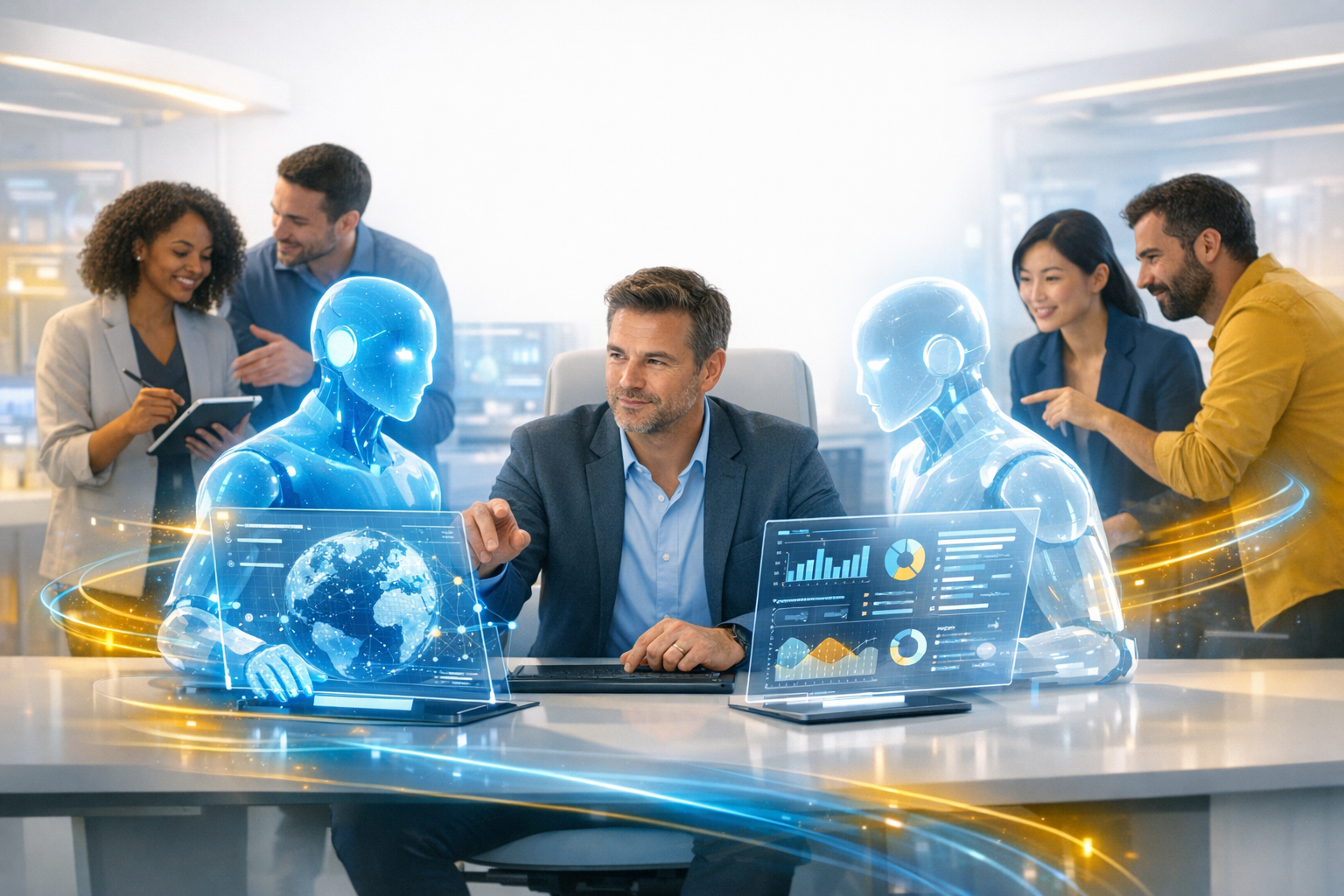
Executive summary: By 2026, AI in the workplace will evolve from isolated pilots to Connected Intelligence-networks of people, AI agents, and AI-to-AI workflows collaborating in real time. Cisco predicts agentic AI will function as embedded digital colleagues, managing monitoring, remediation, and customer engagement alongside humans.[1] For enterprises, the true differentiator will be treating AI as a strategic partner, fully integrating it into the operating model-from strategy design to execution, governance, and ongoing performance steering.
Connected Intelligence: From Apps to Autonomous Collaborators
Until recently, most organizations treated AI as another tool-assistant features in office suites, chatbots for customer support, or pilots within isolated functions. By 2026, this "tool" mindset will no longer suffice.
Cisco's Connected Intelligence model describes a collaboration fabric connecting people to people, people to AI, and increasingly, AI to AI. Here, digital workers (AI agents) continuously summarize meetings, translate languages, surface insights, automate workflows, and coordinate with other agents-all without disrupting human creativity and decision-making.[1]
Key characteristics of a 2026 Connected Intelligence workplace:
- AI coworkers are seamlessly embedded within daily tools-not accessed through separate portals.
- AI-to-AI workflows manage monitoring, remediation, routing, and optimization tasks from end to end.
- Networks and workplaces self-adjust using sensor data, optimizing energy, space, and employee experience in real time.[1]
- Leaders focus on intent and outcomes while AI agents handle much of the data, reporting, and coordination load.
Adoption Is Already at an Inflection Point
This shift is already underway:
- McKinsey reports AI adoption has jumped to 72% of organizations in early 2024, up from ~50% previously.[2]
- Across studies, approximately 70-78% of large enterprises expect to implement AI in at least one function by 2025.[3]
- Generative AI uptake outpaces PCs and the early internet, with adoption rates estimated at 2-3x faster than those previous technology waves.[4]
However, measurable impact still lags:
- Only about 6% of enterprises qualify as "AI high performers"-those that redesign workflows to achieve enterprise-wide financial impact.[3]
- An MIT-related analysis reported that 95% of generative AI pilots show no measurable P&L impact, usually due to poor workflow integration rather than model issues. [5]
In short: most organizations have AI experiments; few have AI-powered operating models.
What 2026's AI-Powered Workforce Will Look Like
To see how AI will reshape work by 2026, consider where Connected Intelligence changes daily operations, IT, and customer engagement.
Strategy, Portfolio, and Performance Management
Today, many enterprises rely on static decks, quarterly reviews, and disconnected KPI spreadsheets for strategy execution. By 2026, Connected Intelligence transforms this:
- AI analyzes OKRs, KPIs, and initiatives as a single system, detecting misalignments between top-level strategy and team goals before they cause inefficiency.
- AI agents become strategic teammates, with roles such as "KPI risk analyst" or "portfolio insights lead," continuously scanning for bottlenecks and recommending where leaders should focus resources.
- Instant summaries replace manual status updates: AI drafts concise, context-rich overviews of progress, blockers, and next actions.
Platforms like Workpath make this possible by integrating strategy, team goals, KPIs, and initiatives in a unified outcome management system, enhanced by AI teammates for actionable insights.
IT and Operations: From Troubleshooting to AgenticOps
Cisco anticipates standard adoption of AgenticOps by 2026-AI agents embedded across IT networks, autonomously detecting anomalies, pinpointing root causes, and resolving issues so IT can focus on policies, architectures, and business goals.[1]
Practically, this means:
- AI-powered NetOps for ongoing optimization of performance, security, and capacity.
- Closed-loop remediation-AI detects and resolves issues, then logs actions taken.
- Operational dashboards instantly populated with real-time risk, SLA, and business impact data.
This trend reflects a broader shift: AI handles monitoring and optimization, while humans focus on design and stakeholder alignment.
Customer and Employee Experience: Hybrid Teams
Cisco experts forecast AI-powered brand concierge agents-multi-agent systems that grasp context and user history to solve customer issues or manage support teams.[1] Leading consulting firms already report over 70% of consultants use internal AI assistants for research and analysis, saving up to 30% of their time.[6]
The hybrid workforce emerges as:
- AI agents manage high-volume, structured interactions and synthesize information.
- Human experts focus on complex problem-solving and building relationships.
- Managers coordinate teams of humans and agents, not just people.
2023 vs. 2026: A Side-by-Side View
| Dimension | 2023 Workplace | 2026 Connected Intelligence Workplace |
|---|---|---|
| Collaboration | Human-to-human via meetings & chat | Human-AI-AI networks with digital coworkers in every major workflow |
| Decision-making | Periodic, based on static reports | Continuous, based on real-time analytics and AI-generated recommendations |
| Strategy execution | Disconnected OKRs, KPIs, and projects | Integrated impact chains linking inputs, outputs, outcomes, and business impact |
| Performance reviews | Manual data collection, slideware, rear-mirror view | AI-orchestrated reviews with automated variance analysis and risk flags |
| IT operations | Ticket-driven troubleshooting | AgenticOps with self-healing networks and AI-assisted NetOps[1] |
| Governance | Sample-based audits | AI audit trails, explainable recommendations, and continuous control checks |
Why Many Enterprises Still Don't See AI Impact
While potential remains high, many enterprises haven't achieved measurable business results with AI. In 95% of generative AI deployments, P&L impact is lacking, largely due to poor integration into core workflows.[5]
Common root causes:
- Tool-first, not outcome-first: AI projects are launched to "test GenAI" rather than solve strategic issues (like slow decisions or misaligned portfolios).
- Fragmented data and metrics: KPIs scattered across tools make it impossible for AI to generate holistic insights.
- Lack of AI governance: Unclear guidelines on explainability, auditability, data residency, or bias impede wider rollout, especially in regulated sectors.
- Insufficient change management: Employees view AI as an add-on, not integral to objectives or incentives.
High-performing organizations approach things differently. They:
- Lead with strategic outcomes and operating model pain points, connecting AI to unified goal and KPI systems.
- Assign AI agents formal roles under governance, not as improvised tools.
- Invest in enablement and leadership practice change.
From Strategy to Execution: Where AI Delivers Most
For strategy, transformation, and IT leaders, the most effective AI application in 2026 will be an AI-powered strategy execution system-connecting goals, data, and work in a live, continually optimized model.
1. Continuous Outcome Management Instead of Quarterly Fire Drills
Modern platforms like Workpath introduce impact chains-clear links between inputs (resources), outputs (projects), outcomes (customer or process changes), and business impact (KPIs). AI then:
- Recommends Objectives and Key Results (OKRs) based on patterns and strategic context, and evaluates their relevance.
- Checks for alignment across teams and strategy, flagging issues early.
- Monitors execution data to surface risks before reviews.
Workpath benchmarks show AI agents that automate data gathering and commentary reduce Business Review prep time by roughly 40%, shifting meetings from reporting to steering.
2. Real-Time Analytics and KPI Governance
AI's impact grows when informed by clean, connected data:
- KPI risk detection: Continuous metric monitoring, risk alerts, and recommendations for leader focus.
- Automated reporting: Dashboards and executive narratives generated from live data, not slides.
- Cross-system integration: Bidirectional data flows from tools like Jira, SAP, and Power BI, so strategy execution aligns with real work.
With customers, Workpath uncovered €2.7M in non-strategic spend, flagged 50+ alignment gaps prior to planning, and illustrated strategy contribution across 400+ projects using structured data and AI analysis.
Manual vs. AI-enabled steering
| Aspect | Manual approach | AI-enabled outcome management |
|---|---|---|
| KPI monitoring | Monthly/quarterly reports | Continuous risk alerts and trend analysis |
| Report creation | Manual, Excel and slides | Auto-generated dashboards and commentary |
| Alignment checks | Ad-hoc, based on intuition | Systematic, prompt detection of misalignments and overlaps |
| Leader time investment | High on aggregation, low on decision quality | Low on aggregation, high on scenario testing and decision-making |
3. Performance Dialogues and Business Reviews
Outcome-driven organizations shift from status meetings to data-driven performance dialogues:
- AI pre-populates reviews with key variances, risks, and suggested discussion points.
- Leaders gain real-time insight into how team OKRs and KPIs link to enterprise outcomes, driving accountability and alignment.
- Follow-up actions integrate as initiatives within impact chains, closing the gap between insight and execution.
4. Change Management and Enablement: Embedding AI in Practice
Successful transformation requires new skills and habits. Leading organizations pair platforms with targeted enablement programs:
- Workpath's AI Bootcamp supports strategy and transformation leads in designing, testing, and deploying AI agents in four sessions-no coding required-using real strategy and KPI data.
- Co-creation formats help teams uncover inefficiencies, define agent roles, and produce actionable prototypes and scaling plans.
A "practice-first" approach distinguishes sustainable AI impact from short-lived hype.
Blueprint: Building a Human-AI Operating Model for 2026
To move beyond pilots, leaders need an operating model blueprint integrating AI with strategy, governance, and daily work.
Step 1: Start with Outcomes, Not Algorithms
- Identify 3-5 critical business outcomes (e.g., faster portfolio steering, reduced non-strategic initiative spending, accelerated transformations).
- Map the current impact chain: inputs, projects, outcomes, KPIs.
- Quantify friction: time spent on data assembly, lag between strategy and reality, decision bottlenecks.
Step 2: Consolidate Goals and KPIs
- Standardize OKR, KPI, and initiative definitions and links.
- Limit metrics to a focused, outcome-oriented set.
- Use a platform that connects strategy, KPIs, and work in one place, laying the foundation for AI insights.
Step 3: Design AI Agents as Team Members
Treat AI as defined roles in your operating model:
- Assign clear responsibilities (e.g., flag KPI anomalies, draft reviews, suggest alignment opportunities).
- Set decision rights-what agents handle autonomously vs. with human oversight.
- Ensure outputs remain explainable and auditable for compliance and trust.
Step 4: Pilot in High-Impact Workflows
Select workflows where AI can prove value quickly and instill new habits, including:
- Business reviews
- Strategic portfolio decisions
- KPI monitoring and risk alerts
- Cross-functional alignment sessions
Track metrics before and after: prep time, decision speed, misalignments detected, financial impact.
Step 5: Scale with Governance and Enablement
- Implement an AI governance framework for data quality, access, auditability, and ethics.
- Train teams and foster communities of practice to share AI best practices.
- Adjust performance management to include AI-enabled outcomes, not just tool usage.
Actionable Next Steps for Enterprise Leaders
Over the next 6-12 months, executives in strategy, transformation, and IT can act:
- Run an AI-readiness check on your strategy execution system: Are goals, KPIs, and initiatives connected or siloed?
- Identify 2-3 high-value AI agent use cases in areas like portfolio steering or KPI risk detection.
- Choose an AI-powered strategy execution platform that unites outcome management, AI agents, and analytics in a single system. Workpath is designed to deliver this end-to-end connection.
- Invest in real-time analytics and KPI governance to provide a solid data foundation for AI.
- Build internal capability-for example, by enrolling leaders in programs like the Workpath AI Bootcamp to make AI tangible for non-technical roles.
To experience this in action, explore Workpath's AI for Strategy Execution and our Analytics Suite for concrete examples of integrated AI agents, impact chains, and real-time analytics.
Frequently Asked Questions
How is "Connected Intelligence" different from traditional automation?
Conventional automation scripts individual tasks. Connected Intelligence orchestrates networks of humans and AI across whole workflows.
AI in this model:
- Understands context across communications, metrics, and work.
- Coordinates with other agents to keep processes moving.
- Delivers insights at the precise decision moment.[1]
Instead of "robots doing tasks," Connected Intelligence augments collaboration patterns.
Will AI agents replace managers or teams by 2026?
Current evidence shows AI is reshaping roles, not replacing them. Consulting firms using AI assistants report significant time savings and new collaboration patterns, not widespread layoffs.[7]
By 2026, expect:
- Less manual coordination and reporting for managers
- Greater focus on setting outcomes, priorities, and making complex decisions
- New roles focused on AI governance, agent design, and outcome management
Organizations embracing AI as a collaborative partner with defined responsibilities and safeguards will foster trust and achieve stronger results.
Which capabilities should an AI-powered strategy execution platform provide?
For mid- to large enterprises, particularly in complex or regulated environments, prioritize platforms offering:
- Unified outcome management connecting strategy, OKRs, KPIs, and initiatives through impact chains
- Embedded AI agents for alignment checks, KPI risk alerts, and automated reporting
- Real-time analytics and Business Review orchestration, including variance analysis and executive dashboards
- Enterprise-ready security and governance (ISO 27001, TISAX, EU data centers, auditable AI decisions)
These features transform AI from a test case into a core layer of the operating model.
How can enterprises ensure AI governance, security, and compliance?
Effective governance combines technical measures and organizational policies:
- Require AI outputs to be explainable and auditable, especially for sensitive decisions
- Enforce data residency and privacy standards (GDPR, industry requirements) with EU data centers and certified security
- Define clear accountability: who approves, monitors, and responds to AI activity
- Integrate AI oversight into existing risk and compliance structures
Where should we start if we've only piloted basic GenAI chatbots?
If your AI experience is limited to copilots or chatbots, move closer to your core steering processes:
- Choose one high-impact workflow (e.g., business reviews, portfolio prioritization) and map its data and decisions.
- Consolidate relevant OKRs, KPIs, and initiatives into a single source of truth.
- Design one or two AI agent roles to safely augment the workflow, such as drafting summaries or flagging misalignments.
- Run a focused 6-10 week pilot with clear metrics-time saved, decision quality, or financial impact.
Then extend to more workflows and formally embed AI into your operating model, supported by enablement programs and governance.