More and more executive boards see their company as “AI‑ready”, while large parts of the workforce feel poorly prepared. The result: a dangerous gap between ambition and reality that slows down AI as a driver of resilience. This article shows how targeted AI enablement, integrated KPI management and a clear connection from strategy to execution help close this gap – and how a platform like Workpath supports you in doing so.
Key insights at a glance: Where companies really stand with AI
- Less than half of employees feel well prepared to work with AI according to current dpa reports – even though many leaders already consider their organization “AI‑ready”. (lz.de)
- Top consultant Christina Raab (Accenture) calls for a shift from “Human in the Loop” to “Human in the Lead”: employees must be actively involved in assessing, deciding on and responsibly using AI. (onetz.de)
- Without systematic AI enablement, investments in AI technology fall short of expectations – efficiency potential, better KPIs and increased resilience are not realized. (de.investing.com)
- Companies that use real time analytics, KPI tracking and clear KPI visualization can identify acceptance gaps faster and take targeted action.
- An integrated outcome management platform with OKR software, KPI software and portfolio management makes it possible to link strategic goals and operational goals with AI initiatives – including change management, governance and compliance (e.g. ISO 27001).
Insight 1: The perception gap – AI readiness is overestimated
Insight in action: How the “AI‑ready” illusion emerges
The current debate around Christina Raab’s statements reveals a clear pattern:
Leadership teams invest in AI technologies, pilot projects and initial use cases – and then rate their organization as “well prepared”. Employees, on the other hand, report that they experience hardly any training, little communication and only limited say in the matter. According to surveys, less than half actually feel confident in working with AI systems. (stern.de)
This perception gap typically arises from three factors:
Technology focus without enablement focus
Deployments of AI tools (e.g. in reporting, customer service or the supply chain) are counted as a success – regardless of whether teams have been enabled to use them in a meaningful way.Lack of transparency around impact on roles and KPIs
Employees often do not know which business goals and KPIs AI concretely influences, how their tasks will change and how performance will be measured in the future.Insufficient KPI management and monitoring
Without consistent KPI tracking, real time analytics and understandable data visualization, there is no clear view of how deeply AI use is actually embedded in day‑to‑day work – and where skepticism or uncertainty dominate.
Practical relevance: Why the gap is dangerous
This gap is more than a perception issue – it has a direct impact on your business strategy and strategy execution:
- Transformation speed drops: If employees do not understand AI or do not trust it, they consciously or unconsciously slow down project execution.
- Business alignment suffers: Strategic goals around AI (e.g. “automating reporting”, “improving forecast quality”) show up on slides but hardly make it into the operational goals of teams.
- KPI effects fail to materialize: Without clear KPI management and systematic KPI tracking, efficiency gains, quality improvements or revenue potential are only visible in isolated cases – the business case for AI remains weak.
The consequence: organizations massively underestimate the enablement and change management share of AI rollouts. Anyone who really wants to use AI as a strategic resilience driver today must invest in people, not just in models.
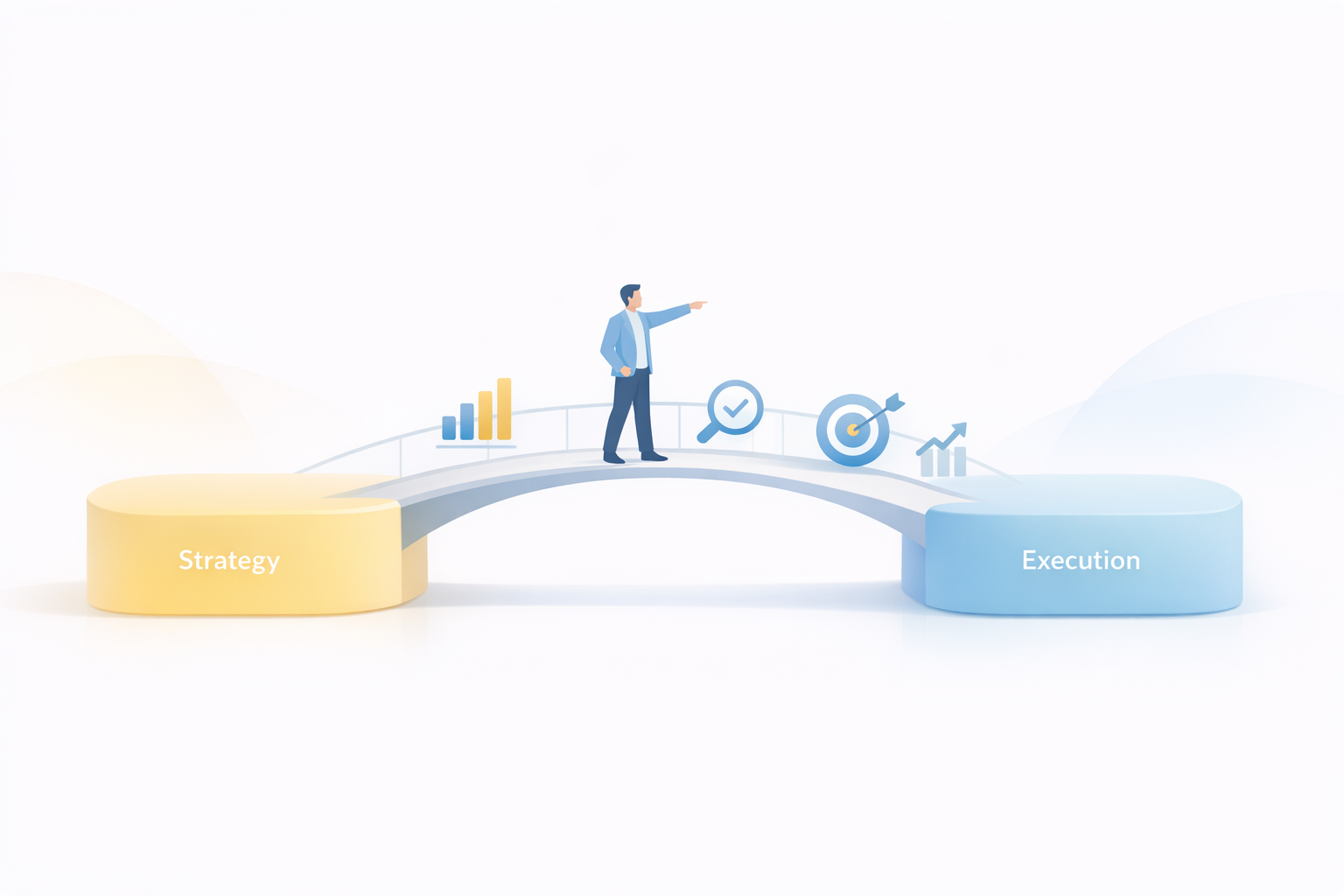
Insight 2: AI enablement is the missing bridge between strategy and execution
Insight in action: From “tool launch” to continuous enablement
Many companies pursue ambitious strategic goals for AI – such as automation in reporting, data‑driven decisions in portfolio management or new digital services. At the execution level, however, a clean strategy‑to‑execution chain is often missing:
- AI goals are described in the corporate strategy but do not appear as concrete OKRs and measurable KPIs at the business unit and team level.
- Enablement activities are limited to one‑off trainings or tool demos.
- Platforms and processes are lacking to measure progress in real time, clarify accountabilities and feed feedback from teams into the further development of AI use cases.
An effective AI enablement program, in contrast, includes:
- Structured OKR and KPI design around AI initiatives (e.g. with OKR software and KPI software),
- targeted training formats – from basics through AI bootcamps to expert roles,
- continuous monitoring using real time analytics, KPI tracking and clear KPI visualization,
- integrated change management that addresses roles, processes and governance.
Practical relevance: How Workpath builds this bridge
Workpath supports companies exactly at this intersection of strategy, people and technology:
- The outcome management platform connects company goals, AI initiatives and operational goals in a seamless strategy‑to‑execution chain.
- With the integrated OKR software, AI‑related goals (e.g. “reduce reporting cycle time by 30%”) are rolled out transparently across all levels.
- Through the Analytics Suite, leaders get real time analytics on goal achievement, the maturity of AI use cases and bottlenecks – including intuitive data visualization.
- Enablement programs such as workshops, trainings and AI bootcamps enable employees to actively use AI and contribute their own ideas – in the spirit of “Human in the Lead”.
This creates a cycle of learning orientation and continuous improvement that firmly anchors AI in day‑to‑day work – and not just in strategy documents.
Insight 3: Governance, security and integration determine trust
Insight in action: Why compliance and integrations strengthen enablement
Especially in regulated or data‑intensive industries (e.g. manufacturing, logistics, energy, finance), security and compliance are key prerequisites for acceptance:
- Leaders must demonstrate that the AI solutions in use are ISO 27001‑compliant, GDPR‑conformant and auditable.
- Employees want to understand how their data is processed, which protection mechanisms are in place and where the limits of AI lie.
There is also the technical perspective: AI only unfolds its full value when it is integrated into existing systems and workflows – for example via SAP integration, interfaces to Jira, BI systems or collaboration tools. Without this integration, AI projects remain isolated solutions that create additional effort and fuel skepticism.
Practical relevance: Trust as a lever for adoption
Workpath addresses these requirements with a clear focus on enterprise security and integration:
- The platform is aligned with ISO 27001 and other relevant security standards and meets high demands on data protection and compliance.
- Through integrations – e.g. SAP integration or connections to existing BI landscapes – KPIs from source systems are transferred directly into KPI management.
- Teams see a consolidated view of KPIs, data visualization and progress of their initiatives in the platform – without media breaks.
The result: greater trust in AI‑supported steering models, better adoption in business functions and a significantly lower manual effort for reporting and management.
Insight 4: Portfolio management & change management – steering AI as a resilience driver
Insight in action: From isolated use case to managed AI portfolio
Many companies start with individual AI use cases – for example forecasting in sales, anomaly detection in production or automated analytics in finance. Without clear portfolio management, however, they lack:
- prioritization along strategic goals,
- transparency on which AI projects contribute what to business goals and KPIs,
- and the ability to quickly shift resources to where the greatest impact is created.
At the same time, every AI project is a change impulse: roles change, processes are adapted, responsibilities shift. Professional change management is therefore not optional – it is essential.
Practical relevance: Measuring and managing resilience
With Workpath, companies can manage their AI portfolio as an integral part of their strategy execution:
- Portfolio management: AI initiatives are linked to clear outcome goals, KPIs and owners.
- Business alignment: All relevant stakeholders can see how individual projects contribute to the corporate strategy and operational goals.
- Change management: Change is supported iteratively via OKRs, reviews and retrospectives – including feedback loops from teams.
- KPI tracking & KPI visualization: Progress, risk profiles and impact become visible through dashboards and real time analytics – turning AI from an experiment into a resilience driver for the organization.
Conclusion and next steps: How to close the AI gap in your organization
The warning about the perception gap around AI is a clear mandate for leadership teams: technology alone is not enough. What matters is enabling employees to take responsibility and actively shape how AI is used.
Three concrete steps you can take now:
Make the status quo measurable
- Systematically assess how prepared your employees feel for AI.
- Use existing KPIs, real time analytics and data visualization to make adoption, usage intensity and impact of your AI use cases visible.
Establish a strategy‑to‑execution chain for AI
- Link your AI ambitions to clearly defined business goals, OKRs and KPIs – supported by OKR software and KPI software.
- Ensure that every initiative in your portfolio management clearly contributes to strategic goals.
Set up AI enablement systematically
- Develop a recurring enablement program consisting of training, bootcamps, coaching and learning communities.
- Combine this with professional change management, governance and a secure, integrated platform (including an ISO 27001‑compliant environment and SAP integration).
Workpath supports you exactly in this: with an outcome management platform that maps strategy to execution, provides KPI management and an Analytics Suite for real‑time steering and, through enablement programs, empowers your teams over the long term. This turns the AI gap into a competitive advantage – and uncertainty into sustainable business success.
Frequently Asked Questions (FAQ)
How can I practically measure the perception gap around AI in my company?
Start from two perspectives:
- Employee perspective: Run short, regular surveys (e.g. “How well prepared do you feel for AI?”; “Do you understand how AI will affect your role?”).
- Strategy and KPI perspective: Use KPI tracking and real time analytics to analyze how intensively AI use cases are actually used and which KPIs they influence.
A platform like Workpath helps bring these data points together, make them understandable through data visualization and anchor them in your steering model.
What role do OKR software and KPI software play in AI enablement?
OKR software ensures that strategic goals for AI are cleanly translated into operational goals and concrete initiatives. KPI software – ideally integrated into an outcome management platform – makes the impact of these initiatives measurable: you can see which AI projects contribute to revenue, efficiency or quality.
In combination, both create a transparent strategy‑to‑execution chain in which teams can understand why they are using AI and how success shows up in KPIs.
How important is ISO 27001 and other security standards for AI acceptance?
Especially in larger and regulated organizations, trust in security and compliance is a key success factor. ISO 27001 and comparable standards signal that information security is embedded in a structured way – a strong argument for works councils, IT security and employees.
If your AI‑supported steering platform (such as Workpath) meets these standards, it becomes much easier to implement sensitive use cases and actively involve employees.
How can I better integrate AI initiatives into my existing portfolio management?
Do not treat AI projects as special cases, but as a core part of your transformation tool and portfolio management:
- Capture all AI use cases centrally with goals, KPIs, resources and owners.
- Link them to relevant business goals and strategic programs.
- Use a platform that combines portfolio views, KPI tracking, data visualization and collaboration.
This makes it transparent where AI is really creating value – and where you need to adjust or reprioritize.
What sets Workpath apart from classic goal management or BI tools in the context of AI?
Classic goal management tools focus primarily on goal setting; BI tools on reporting. Workpath goes one step further:
- Outcome management: Connects corporate strategy, OKRs, KPIs and initiatives along the entire strategy‑to‑execution chain.
- Integrated Analytics Suite: Provides real time analytics and KPI visualization directly in the context of goals and actions.
- Enablement & change: Supports organizations with programs, trainings and AI bootcamps to embed AI and modern steering models in a sustainable way.
This makes Workpath a central transformation tool that aligns technology, people and business strategy – and helps you close the AI perception gap for good.